
Showing posts with label Fashion Icon. Show all posts
Showing posts with label Fashion Icon. Show all posts
Wednesday, September 5, 2012
First Look at Iris Arpfel Documentary


Monday, May 14, 2012
Monday, April 16, 2012
Cristóbal Balenciaga’s Personal Archives on Display for First Time
Gabrielle “Coco” Chanel praised Cristóbal Balenciaga as ”the only true couturier among us” and Christian Dior referred to him as “the master of us all.” Now 40 years after his death, the master’s personal archives will go on public display for the first time at Paris’ Musée Galliera, featuring documents, costumes, fabric fragments and even doll’s clothes that were bequeathed to the museum in 1979.

 As he was greatly influenced by the 19th century, despite revolutionizing women’s fashion in the 20th, the exhibition brings together Balenciaga’s creations with some of the sources of his inspiration. To wit, Balenciaga’s sculptural couture confections are juxtaposed with their historical counterparts from 100 years earlier.

“It’s very random, spontaneous — put together over the course of a lifetime, travelling round the world, presents from friends. He wasn’t a specialised collector,” said Galliera director Olivier Saillard.
 As he was greatly influenced by the 19th century, despite revolutionizing women’s fashion in the 20th, the exhibition brings together Balenciaga’s creations with some of the sources of his inspiration. To wit, Balenciaga’s sculptural couture confections are juxtaposed with their historical counterparts from 100 years earlier.
“He invented, at least in part, the vocabulary of 20th century fashion,” noted Saillard, “yet the paradox is he was very nourished by the epoch before.”
One cannot fully discuss Balenciaga without mention of his passion for Spanish religious dress and regional costume, which the exhibition duly explores with formal coats inspired by the vestments of cardinals and boleros and capes reminiscent of those worn by bullfighters on display.
Cristóbal Balenciaga: Collectionneur de modes opens today in Paris and will run through October 7, but if you can’t make it to the City of Lights by then, try to console yourself with this write-up of the Queen Sofia exhibit on Balenciaga that closed in February
Thursday, February 16, 2012
R.I.P. Style Icon Zelda Kaplan
 Zelda Kaplan, a beloved socialite, fashion icon and humanitarian, passed away today while sitting front row at Joanna Mastroianni’s show at Lincoln Center. According to the New York Post, witnesses saw Kaplan “slump forward” in her seat after the models had started walking down the runway. Security carried her out of the show, where EMT’s gave her CPR before an ambulance arrived and took Kaplan to the hospital.
Kaplan’s friends gave the Post the following statement: “Zelda Kaplan passed away suddenly today at the age of 95 from natural causes, she was surrounded by friends and family. She will be deeply missed and always loved.”
Kaplan was known for her distinctive style, favoring bold African prints, hats and oversized sunglasses–as well as her youthful spirit and boundless energy. She was referred to as a “club kid” and an “It girl” well into her golden years.
A quick Google search turns up endless gushing about the advanced style icon, from her style to her impressive nightlife escapades to her humanitarian efforts in Africa. We’re most inspired by Kaplan’s refusal to accept the notion that getting old is a bad thing. In 2010, she told Stylelikeu, “So many young people are so afraid of becoming old. I would like them to know that from someone who is ninety-four years young, it is fun to be old.” She was one amazing lady whose absence won’t go unnoticed.
You’d be hard-pressed to think of a better example of someone who lived life to the fullest. Click through for more pictures and an incredibly endearing video of her talking about turning “95 years young” from Advanced Style, where she of course made several appearances. And don’t miss this poignant story about Zelda from Lucky‘s Ray Siegel.
Tuesday, November 29, 2011
Fashion Icon: Audrey Hepburn
 Audrey Hepburn, Actress
Why? Because window-shoppin and munching a croissant will never again be that elegant. neither will a black turtleneck with black cigarette pants. A little black dress that she wore in Breakfast with Tiffany's sold at action for nearly a million dollars- & the proceeds built a school for improvised children in India. (and because being an humanitarian is always in style)


Everything You Need to Know About Today’s Top Fashion Photographers
 In the world of fashion there is a small yet consistent collection of photographers who get the majority of work for major publications and brands. In fact, many of them seem to have quite the monopoly on the fashion world. Legends like Richard Avedon and Irving Penn continued to work prolifically up until the time they passed away, and that seems to be what is so great about being behind the camera instead of in front of it. Top photographers are given the chance to work for years in an industry where most figures are in one day and out the next.
But how do you differentiate one top photographer from another? You'll see what to look for from visual style, what publications they regularly appear in, as well as recent ongoing collaborations with brands and models of some of the top working fashion photographers of today. enjoy!
Sunday, November 6, 2011
A Tribute to the Iconic Style of Loulou de la Falaise, Muse to Yves Saint Laurent
 Loulou de la Falaise, the iconic muse and collaboratrice of Yves Saint Laurentdied yesterday. She was 63.
In a 2002 New Yorker article about Yves Saint Laurent, writer Judith Thurman called “the quintessential Rive Gauche haute bohémienne” by the New Yorker, de la Falaise’s style served as the inspiration for YSL’s Le Smoking suit and YSL’s classic sheer blouse, a style de la Falaise often wore herself.

Thought it fitting to remember Loulou de la Falaise through her incredible influential style. Take a look...


Tuesday, November 1, 2011
"Loose As a Goose" Funny Lady Iris Apfel
 When Apfel opens the door to her apartment in a beautiful Park Avenue building she is wearing an unremarkable outfit of jeans and a grey sweater: 'The jeans are from - what's that cheap store? Old Navy - but the sweater is cashmere.'
...
'You can't try to be somebody you're not; that's not style. If someone says, "Buy this, you'll be stylish," you won't be stylish because you won't be you. You have to learn who you are first and that's painful.'
When I ask her if she has learnt who she is, she answers enigmatically. 'I don't try to intellectualise about it because it tightens you up. I think you have to be loose as a goose.'
...
'It was fabulous then, everyone looked beautiful,' she says in her low drawling voice that sounds like it comes out of a 1950s Hollywood film.
'Now when I walk down Fifth Avenue in the summertime I just want to throw up. It seems that the fatter and uglier people are, the fewer clothes they wear. The shorts and flip-flops and tight jeans on butts that go from here to Poughkeepsie.'
She shudders. 'I always say they should put people in jail for wearing clothes like that. Especially stretch jeans over size 10 [a UK size 14] - they should be outlawed. Ten years ago people were starting to look like slobs in New York, now it's an epidemic.'
...
'I haven't been in London for some years but the last time I was there they looked fuddy-duddy and school-marmish, yes, but not slobby. And then there are the wonderful eccentrics like the kids on Carnaby Street or the punks or whatever the heck they are.'
...
She became friends with Duke Ellington, whom she first met when she was writing a paper on jazz. Hearing he was in town, she went to see him. 'I got all dressed up; I think I had more nerve than brains. I went backstage and knocked on the door and Ray Nance [Ellington's trumpeter] came out and said, "Lordy, lordy, who's your tailor?"
The Telegraph: New York doll: interview with the socialite Iris Apfel
Friday, October 21, 2011
Fashion ICON: Katherine Hepburn

Why? Because she was "yare"- nimble, lively, agile. The word she & Cary Grant used to describe their sailboat in Philadelphia Story also applies to the leading lady, known for her lean, athletic look and her sexy, convention- busting pants and heels. In 1985, the Council of Fashion Designers of America gave her a Lifetime Achievement Award for her nonconformist role in modern fashion.


Tuesday, October 11, 2011
Vintage Fashion Show: Claude Montana 1988
Claude Montana is a French fashion designer. His company, The House of Montana, founded in 1979, went bankrupt in 1997.
 Born in Paris in 1949 to a Catalonian father and German mother, Montana began his career by designing papier-mâché jewelry covered with rhinestones. Later, he discovered leather and the complex techniques associated with it, eventually becoming a leading force in leather. His first fashion show took place in 1976. He was an avid colorist and favored blue, red, metallic, and neutral tones, in luxurious materials such as cashmere, leather and silk. He started his own company in 1979, and quickly became a darling of 1980s high fashion along with Thierry Mugler, who also favored aggressive shapes and strong colours.


Monday, August 1, 2011
Icon: Happy Birthday Yves!

Today would have been the 75th birthday of fashion legend Yves Saint Laurent. While the man himself may no longer be with us, his legacy is among the most poignant in contemporary fashion.
In honor of YSL’s birthday, we take a look back on his most unique and memorable designs, as well as a look at the life of the man himself.
So take a peek into the history of YSL. It’s great inspiration.


Tuesday, July 19, 2011
Icon: Iris Apfel
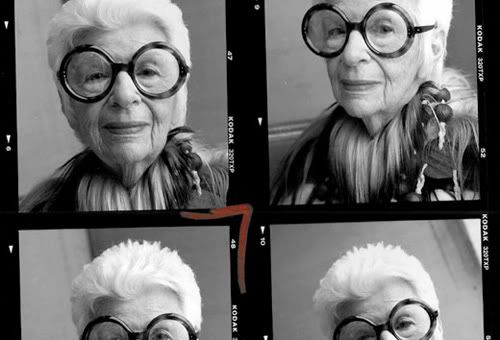
Iris Apfel (born Astoria, Queens, New York, 29 August 1921) is an American businesswoman, former interior designer, and fashion icon.
Born Iris Barrel, she was the only child of Samuel Barrel (born 1897), whose family owned a glass and mirror business, and his Russian-born wife, Sadye (aka Syd), who owned a fashion boutique.
She studied art history at New York University and attended art school at the University of Wisconsin. As a young woman Barrel worked for Women's Wear Daily and for interior designer Elinor Johnson. She also was an assistant to illustrator Robert Goodman.
 In 1948 she married Carl Apfel. Two years later they launched the textile firm Old World Weavers and ran it until they retired in 1992. During this time, Iris Apfel took part in many design restoration projects, including work at the White House for nine presidents: Truman, Eisenhower, Nixon, Kennedy, Johnson, Carter, Reagan, and Clinton.

Iris Apfel still consults, and also lectures about style and other fashion topics. She calls herself a 'geriatric starlet' but she's fashion's latest muse, inspiring everyone from designers to glossy magazine editors. Iris Apfel talks to Gaby Wood about a lifetime's obsession with dressing up – and why she'd never spend more than $15 on a pair of jeans
 In 2005, the Metropolitan Museum of Art in New York City premiered an exhibition about the fashionable style of Iris Apfel entitled Rara Avis (Rare Bird): The Irreverent Iris Apfel. The success of the exhibit was profound that planted the seed for traveling versions of the exhibit displayed at the Norton Museum of Art in West Palm Beach; the Nassau County Museum in Nassau County, New York; and the Peabody Essex Museum in Salem, Mass. The Museum of Lifestyle & Fashion History in Boynton Beach is in the conceptual phase of a 93,000 square feet (8,600 m2) new building that will include a dedicated gallery for the clothes, accessories and furnishings of Iris Apfel.
Apfel is 88, a "geriatric starlet" (her own description) who has suddenly become a staple of hip New York life – photographed by Bruce Weber, admired by designers such as Isaac Mizrahi and Duro Olowu, featured in Paper magazine, Vogue and the New York Times, blown up beyond life-size in the window of Barneys department store. In the five years since a show of her clothes at the Metropolitan Museum's Costume Institute was a word-of-mouth sensation, she has taken the world of style by storm. Her looks are now so legendary, so otherworldly, that many who first saw the exhibition assumed she was dead. Her nephew made a habit of taking friends to see it, and she gave him strict instructions: "If you hear anyone say I'm dead, tell them: 'No, she's very much alive and just walking around to save funeral expenses.'"

Apfel thinks her sudden cult status is very funny. There she was, as she sees it, minding her own business. The Costume Institute wanted to borrow some of her accessories, and then they thought perhaps they should borrow some clothes to put them in context. "I said: 'Oh that's a great idea. What would you like?'" Apfel recalls. "They said: 'Well, we don't know. What have you got?' That opened the Pandora's box. They started to go through all the closets, all the armoires, all the drawers, all the boxes, things on top of the closets, under the bed… they kept dragging things out and oohing and ahhing. Before you know it, we had to push all the furniture to one side, and we had to buy 10 pipe racks to hang stuff."
A version of the show is now on view at the Peabody Essex Museum in Salem, Massachusetts, and some of the setups are so delirious they look as though they might have travelled directly from the mind of Luis Buñuel. A feather-clad mannequin sits astride an ostrich; an ensemble made to order entirely of leopard-print velvet (coat, skirt, boots, bag) is worn by a mannequin leading a leopard by a rope – the leopard is wearing Apfel's glasses. "There's a sad lack of glamour in the world today," Apfel mourns. "And there's absolutely no fantasy."


Tuesday, June 7, 2011
Icon: Elsa Schiaparelli
 Elsa Schiaparelli (Italian pronunciation: [ɛlsa skjapaˈɾɛlːi]; 10 September 1890 — 13 November 1973) was an Italian fashion designer. Along with Coco Chanel, her greatest rival, she is regarded as one of the most prominent figures in fashion between the two World Wars. Starting with knitwear, Schiaparelli's designs were heavily influenced by Surrealists like her collaborators Salvador Dalí and Alberto Giacometti. Her clients included the heiress Daisy Fellowes and actress Mae West.
Schiaparelli did not adapt to the changes in fashion following World War II and her business closed in 1954.
Schiaparelli was born at the Palazzo Corsini in Rome. Her mother was a Neopolitan aristocrat and her father a renowned scholar and curator of medieval manuscripts. Her father, Celestino, was Dean of the University of Rome and an authority on Sanskrit. She was a niece of astronomer Giovanni Schiaparelli, who discovered the canali of Mars, and she spent hours with him studying the heavens. She studied philosophy at the University of Rome, during which she published a book of sensual poems that shocked her conservative family. Schiaparelli was sent to a convent until she went on hunger strike and at the age of 22 accepted a job in London as a nanny. Elsa led a refined life with a certain amount of luxury provided by her parents’ wealth and high social status. She believed, however, that this luxury was stifling to her art and creativity and so she removed herself from the “lap of luxury” as quickly as possible. Schiaparelli moved first to New York City and then to Paris, combining her love of art and design to become a surrealist couturier.

Schiaparelli was later introduced to Gaby Picabia, ex-wife of French Dadaist artist Francis Picabia and owner of a boutique selling French fashions in New York. Through her work there, Schiaparelli met artists like Marcel Duchamp and Man Ray. When Gaby and Man Ray left for Paris, Schiaparelli joined them.


A darker tone was set when France declared war on Germany in 1939. Schiaparelli's Spring 1940 collection featured "trench" brown and camouflage print taffetas. Soon after the fall of Paris on 14 June 1940, Schiaparelli sailed to New York for a lecture tour; apart from a few months in Paris in early 1941, she remained in New York City until the end of the war. On her return she found that fashions had changed, with Christian Dior's "New Look" marking a rejection of pre-war fashion. The house of Schiaparelli struggled in the austerity of the post-war period, and Elsa finally closed it down in December 1954, the same year that her great rival Chanel returned to the business. Aged 64, she wrote her autobiography and then lived out a comfortable retirement between her apartment in Paris and house in Tunisia. She died on 13 November 1973.
 Schiaparelli was an innovative woman and fashion designer. She had a lot of "firsts" in the fashion industry. Her career began with her introduction of graphic knitwear to the world of fashion with knit patterns and emblems. These led to her fanciful prints of body parts, food, and many more unusual themes. She was the first to use brightly colored zippers, appearing first on her sportswear in 1930 and again five years later on her evening dresses. Not only was she the first to use brightly colored zippers, but she was also the first to have them dyed to match the material used in her garments. She was the first to create and use fanciful buttons that looked more like brooches. They came in the shapes of peanuts, bees, and even ram’s heads. In Parisian fashion, she invented culottes, introduced Arab breeches, embroidered shirts, wrapped turbans, pompom-rimmed hats, barbaric belts, the “wedge,” a soled shoe that would trend through the 20th century and into the next, and mix-and-match sportswear, the concept of which would not be fully recognized for another forty to fifty years. While her innovations in fashion design were numerous, it was her creation of the runway show as we know it today that was most influential. Her modern idea of a fashion show included a runway with music and art, and the use of elongated, shapeless women as models. She believed that this boyish figure would best display the clothing. Many people do not realize the true sum of her impact on fashion and the fashion industry.


Artist Collaborations
 Modern art, particularly Dada and Surrealism, provided a significant source of inspiration for Schiaparelli. She worked with a number of contemporary artists to develop her imaginative designs, most famously with Salvador Dalí. From these artistic collaborations, Schiaparelli’s most notable designs were born. In addition to well-documented collaborations such as the shoe hat and the Tears dress, Dali's influence has been identified in designs such as the lamb-cutlet hat and a 1936 day suit with pockets simulating a chest of drawers. Schiaparelli also had a good relationship with other artists including Leonor Fini, Jean Cocteau, Meret Oppenheim, and Alberto Giacometti. Chanel referred to her as 'that Italian artist who makes clothes'.


Subscribe to:
Posts (Atom)